
Science and Religiosity
About the workshop
Key information
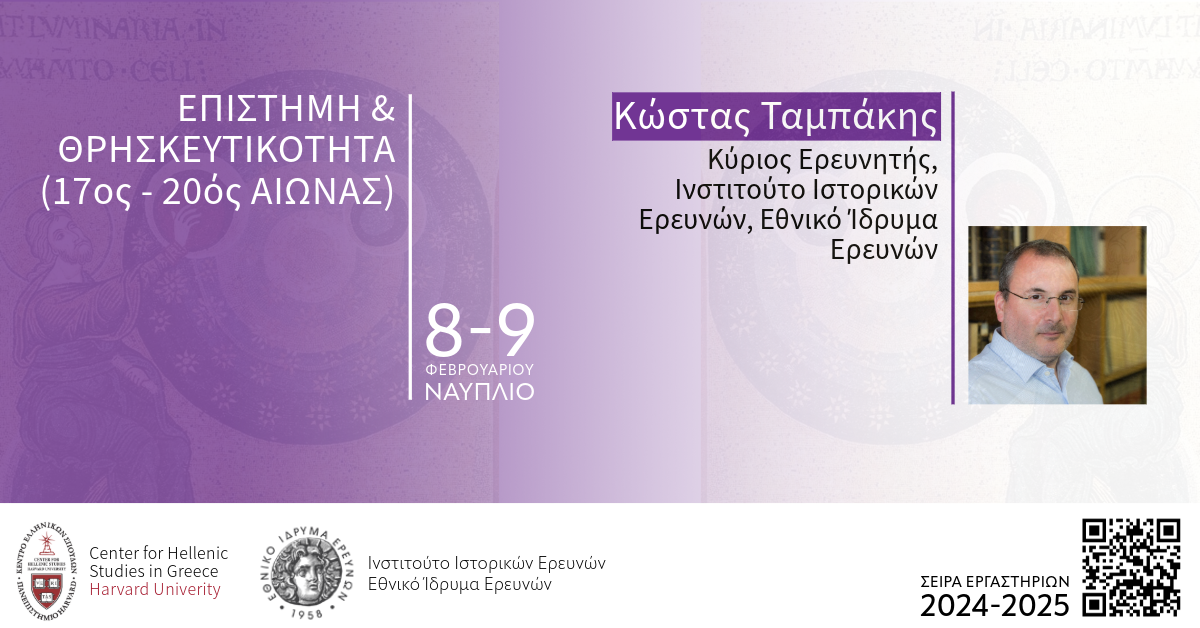
- Full title: Science and Religiosity in Greek-speaking regions and beyond (17th-20th centuries)
- Dates: February 8-9, 2025, 11:00am-3:00pm
- Location: CHS Greece, Nafplio
- Organized by: CHS Greece, Institute of Historical Research of the National Hellenic Research Foundation (IHR/NHRF)
- Open to: All (limited number of places, up to 20 participants)
- Language: Greek
- Application period: December 2, 2024-January 20, 2025
- Academic coordination: Kostas Tampakis (Senior Researcher, Section of Neohellenic Research, Institute of Historical Research of the National Hellenic Research Foundation)
- Activity administration: Matina Goga (CHS Greece)
- Contact number and email: (+30) 27520 47030, int. line 1, matina.goga@chs.harvard.edu
Overview
The Center for Hellenic Studies in Greece is collaborating with the Institute of Historical Research of the National Hellenic Research Foundation in organizing the workshop titled "Science and Religiosity in Greek-speaking regions and beyond (17th-20th centuries)." CHS Greece, through its annual workshop series, aims to support Hellenic Studies and the broader field of Humanities, and to offer intergenerational, interdisciplinary, lifelong learning opportunities to the public.
In this workshop, we will discuss the interplay between religious practices and religiosity on the one hand, and the study of nature on the other from the 17th to the 20th century. Stereotypically, natural sciences are identified with rationalism, while religion with dogma. In contrast to these narrow interpretations, we aim to highlight the complexity of the ways in which those two important aspects of human civilization have interacted. During the workshop, we will follow the historical path of their relationship with the Greek-speaking populations and wider Europe. The debate will guide us from Galileo to Sputnik and from Kazantzakis to Newton.
Thematic areas – Workshop structure
The approach to the topic will be organized around the following thematic axes:
- Religion and the Scientific Revolution
- The challenge of the Modern Greek Enlightenment
- Man in science and religion
- Atheism and science
The coordinator will present the abovementioned topics, emphasizing the activities of eminent figures such as Galileo and Newton, and highlighting the science's relationship with art and philosophy of the time. Paintings, photographs and other artistic displays will be presented during the workshop. The aim is for the participants to take part in the dialogue actively. Finally, the workshop will feature specialized documentaries and a following discussion.
This workshop aims to delve into the complexity of the ways in which scientific and religious practices came into contact, emphasizing the importance of understanding the historicity of both fields in examining their interaction. It seeks to explain how atheism became culturally and socially intertwined with the study of nature and to critically examine the most important episodes of conflict between religion and science. Additionally, the workshop will discuss the relations between religion and science in the Greek-speaking area, drawing on specific examples.
Learn more about the participation process of the workshop on Science and Religiosity (in Greek).
Accessibility in our workshops
The Center for Hellenic Studies in Greece welcomes individuals with disabilities to participate in its workshops and activities. If you would like to request accommodations or have questions about the physical access provided, please email matina.goga@chs.harvard.edu or call (+30) 27520 47030 and then press "1," in advance of your participation. Requests for accommodations should be made as far in advance as possible. We will explore each request on a case-by-case basis. However, please note that all services are subject to availability.