
Sport and Education Program: from Ancient Olympia to the Present
About the program
Κey information
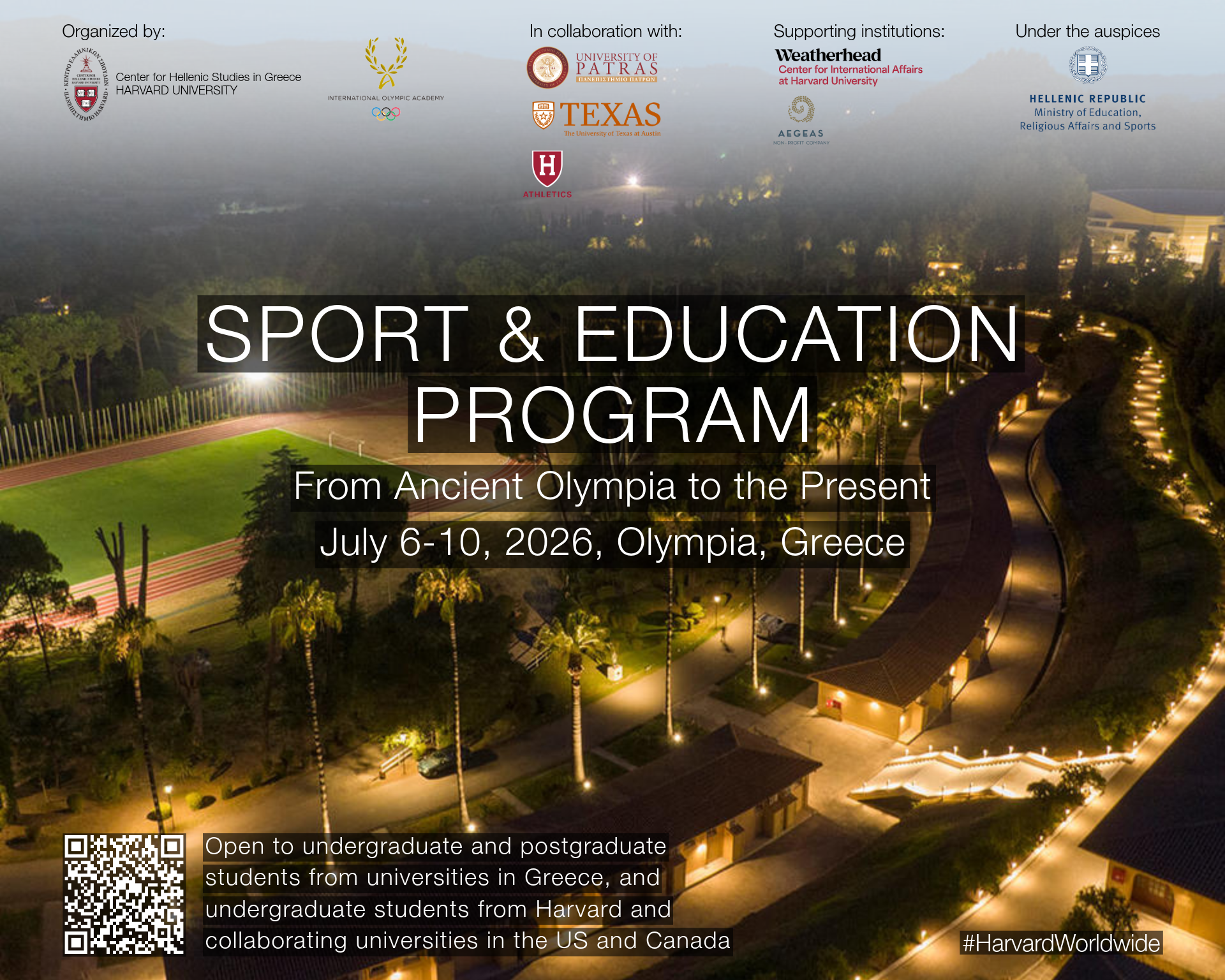
- Dates: July 6-10, 2026
- Location: International Olympic Academy (IOA) premises, Olympia, Greece
- Organized by: CHS Greece, IOA, in cooperation with Harvard Athletics, University of Patras, and Stark Center for Physical Culture and Sport at the University of Texas at Austin, with the support of Harvard’s Weatherhead Center for International Affairs, and the AEGEAS Non-Profit Civil Company, and under the auspices of the General Secretariat of Sport, Ministry of Education, Religious Affairs and Sports, Hellenic Republic
- Open to: Harvard undergraduate student-athletes (up to 5 participants); undergraduate students from collaborating universities in the US and Canada: University of Texas at Austin, Dartmouth College, Pennsylvania State University, and University of Toronto (up to 10 participants); undergraduate students from any department who are in their third year or higher as well as postgraduate students from any department (Master's and PhD) from universities in Greece (up to 35 participants)
- Application period for Harvard students: December 5, 2025-February 24, 2026 (via CARAT)
- Application period for students from the collaborating universities in the US and Canada: December 5, 2025-extended to March 19, 2026 (via the CHS Greece forms website)
- Application period for students from universities in Greece: January 19-March 19, 2026 (via the CHS Greece forms website)
- Language: English
- Faculty: Prof. Charles Stocking, Academic Director of the program (University of Texas at Austin/CHS), Dr. Georgios Mouratidis (British School at Athens), Prof. John Zilcosky (University of Toronto), Prof. Mark Dyreson (Pennsylvania State University)
- Guest speakers: Panagiotis Pelekoudas (Coach, General Secretary of the Panhellenic Association of Professional Volleyball Players, and former international volleyball player), Dimitra Papadimitriou (Professor, Department of Business Administration, University of Patras), Cory Johnson (Assistant Librarian and Researcher at Texas Tech University, Expert on Mixed Martial Arts, Sanda, Muay Thai, Brazilian Jiu Jitsu and Kickboxing, and former Coach of the USA National Sanda Team), Ted Minnis (Men's and Women's Water Polo Head Coach, Harvard University)
- Activity Administration: Evan Katsarelis (CHS Greece), Marilena Katsadoraki (IOA)
- Contact email: programs-eventsgreece@chs.harvard.edu
Overview
We are happy to announce the 2026 Sport & Education Program: from Ancient Olympia to the Present that will take place in Olympia under the auspices of the Greek General Secretariat of Sport. For five days this summer a diverse body of students and faculty will convene in the birthplace of the Olympic Games, to examine how sport shaped ancient models of knowledge, and how, in turn, the ancient athletic-knowledge complex, known as paideia, served as a model for modern universities and professional sports.
In the state-of-the-art facilities of the IOA, during plenary sessions and small-group discussions, participants will engage in experiential learning, conversation, and debate around key themes and topics introduced by the faculty, offering a unique opportunity to explore the historical, social, and practical connections between sport and education, from the ancient Olympics to the modern university system. Additionally, faculty-led sessions on the archaeological site and museum of Ancient Olympia, and the Museum of the History of the Olympic Games of Antiquity, will give students a sense of vital connection to the embodied past. This year, participants will also have the opportunity to attend a panel discussion with guest speakers who are distinguished Greek athletes, Panagiotis Pelekoudas and Dora Goudoura.
The list of faculty members for this year’s program consists of:
- Charles Stocking, Academic Director of the Sport and Education Program, Associate Professor at the Department of Kinesiology and Health Education, University of Texas at Austin, and Associate of the Center for Hellenic Studies, Harvard University
- Georgios Mouratidis, Assistant Director of the British School at Athens
- John Zilcosky, Professor of German and Comparative Literature at the University of Toronto
- Mark Dyreson, Professor of Kinesiology, Affiliate Professor of History at the College of Health and Human Development, and Director of Research and Educational Programs for the Center for the Study of Sports in Society, Pennsylvania State University
The list of guest speakers for this year’s program consists of:
- Panagiotis Pelekoudas, Coach, General Secretary of the Panhellenic Association of Professional Volleyball Players, and former international volleyball player
- Dimitra Papadimitriou, Professor, Department of Business Administration, University of Patras
- Cory Johnson, Assistant Librarian and Researcher at Texas Tech University, Expert on Mixed Martial Arts, Sanda, Muay Thai, Brazilian Jiu Jitsu and Kickboxing, and former Coach of the USA National Sanda Team
- Ted Minnis, Men's and Women's Water Polo Head Coach, Harvard University
Framework & goals
It is well acknowledged that the modern Olympic revival movement began, in part, as an effort to reform the educational systems of Greece, Europe and North America in light of the Classical past. According to Pierre de Coubertin, it was the ancient Greek gymnasium, with its focus on the cultivation of mind and body, which served as the inspiration and model for the modern Olympics. At the same time, the precise role that sport should continue to play in education, especially at the university level, is currently an object of intense debate and controversy.
Because the topic of sport and education is not only an object of academic interest, but also presents modern practical issues, this program will depart from traditional academic style programs, aiming to create sustained dialogue between historians, exercise scientists, sports psychologists, coaches, athletes, and students from around the world. Scholars and professionals will come together to explore the history of sport with a specific view to its future role in education. In the program, students from Europe and North America will have the opportunity to experience the archaeology of ancient Olympia while engaging in historical inquiry, philosophical debates, and hands-on practical exercises related to mind-body learning. Thus, the unique combination of speakers, participants, and activities will allow for three major learning outcomes:
- increased historical knowledge on the Classical past and its influence today;
- new pedagogical methods;
- and new perspectives on future best practices and policies at every level of the global sport-education complex.
The expansion of these goals is designed to continue in future years, with the development of a dedicated open-access online database of written resources and multimedia.
Seminars
The program, apart from other activities, will include small group seminar-type sessions, bolstered by the exchange of ideas and fruitful discussions between faculty and students. Each seminar day will center around one main theme.
Day 1 (July 6): Introduction
Following arrivals at the IOA in Ancient Olympia, there will be an introduction to the program's key themes and objectives. The discussion will cover the seminar structure, student participation, and their relationship to the museum and site visits in Olympia.
Day 2 (July 7): Sport and Education in Ancient Greece
Organized, civic education in Ancient Greece was intimately associated with athletic training beginning as early as the sixth century BC. Throughout the Archaic and Classical periods, ancient gymnasia became an increasing central aspect of every Greek city. From ancient sources pertaining to Athens, Sparta, and elsewhere, it became clear that the practice of paideia through athletic training was to cultivate values such as excellence, courage, moderation, endurance as well as beauty. Indeed, the values of education and athletics were often debated, and this is perhaps why ancient gymnasia were not only places of basic physical and mental education but were also major venues for the development of philosophy. These first two days will therefore give students an opportunity to explore the history of interdependence between athletics and education in ancient Greek culture.
On this day, students will be guided on an archaeological tour of the site of Olympia and the Archaeological Museum. Students will be encouraged to explore how the ideals of ancient sport relate to the material culture and practice of the ancient Olympic Games.
Day 3 (July 8): Sport, Education, and Olympic Revival
Education played an equally influential role in the "rediscovery" of sport with the modern Olympic movement. Indeed, education was a vital component of indigenous Olympic revival movement in Greece and the Zappas Olympics. In addition, through the International Olympic Committee, Pierre de Coubertin established a philosophy of "Olympism" as a distinct mode of education.
Yet, the topic of education and the Olympics in the late nineteenth and early twentieth century also introduced major social issues, specifically centered around class and amateurism. Hence, seminars on this day will engage students with both the positive outcomes and problems that remain with regard to the early history of education and the modern Olympic movement.
On this day, students will also be guided through the Museum of the History of the Olympic Games. Here students will be encouraged to consider how the practice and history of the ancient Olympics shaped the modern Olympic revival and education.
Day 4 (July 9): Sport and Education today
The relationship between athletics and education remains fundamental today at a global scale. In fact, student-athletes comprise a large majority of current national Olympic teams. At the same time, the relationship between sport and education has also become increasingly more strained as a result of outside pressures from media and the economy. In this fourth day of seminars, students will examine the relationship between sport and education today specifically in light of the ancient and early modern past.
Furthermore, on this day of the program, students will participate in an open panel-discussion between faculty and guests of the program. In this discussion, faculty, guests, and students will have the opportunity for more direct communication regarding their own personal experiences in the fields of sport and education, and the connections between the two. This session will provide an ideal opportunity to think deeply about issues of sustainability and practicality regarding the future of sport and education, at both a personal and institutional level.
Day 5 (July 10): Wrap-Up Session
On the final day the Academic Director and faculty of the program will share closing thoughts, while answering questions from the students. The program will conclude with the distribution of certificates of participation to the students. After the closing session, students will depart from the IOA premises in Ancient Olympia.
Eligibility & application procedure
This activity is open to Harvard undergraduate student-athletes (up to 5 participants); undergraduate students from collaborating universities in the US and Canada: University of Texas at Austin, Dartmouth College, Pennsylvania State University, and University of Toronto (up to 10 participants); undergraduate students from any department who are in their third year or higher as well as postgraduate students from any department (Master's and PhD) from universities in Greece (up to 35 participants). We welcome applicants with a demonstrated current affiliation and interest in sport. By establishing a diverse participant pool, the students will be able to learn as much from each other’s experiences and perspectives as they will from the invited speakers.
This is a non-fee-based activity, and participants will be given certificates of participation during the closing session of the Program.
Applications for students from Harvard will remain open between Friday, December 5, 2025, and Tuesday, February 24, 2026 (midnight, Eastern European Time). Applicants will receive notification of the selection committee's decision by the end of March.
Applications for students from the collaborating universities in the US and Canada will remain open between Friday, December 5, 2025, and Thursday, March 19, 2026 (midnight, Eastern European Time). Applicants will receive notification of the selection committee's decision by the end of April.
Applications for students from universities in Greece will remain open between Monday, January 19, 2026 and Thursday, March 19, 2026 (midnight, Eastern European Time). References must be submitted by Monday, March 23, 2026 (midnight, Eastern European Time). Applicants will receive notification of the selection committee's decision by the end of April.
Selected participants will receive acceptance messages via email, along with instructions regarding the confirmation of their participation and the submission of related forms.
Please ensure that you submit the application form that corresponds to the university where you are a student. The application process utilizes separate portals for Harvard students, for students from the collaborating universities in the US and Canada, and those from universities in Greece. Below are instructions for each category:
Information for Harvard applicants:
Prospective candidates from Harvard University who are interested in this program should be undergraduate student-athletes and must apply online via Harvard CARAT. Scholarship opportunities for Harvard undergraduates are provided by Harvard University’s Center for Hellenic Studies and the Weatherhead Center for International Affairs, with administrative support from Harvard Athletics. Harvard candidates can find additional details about their participation by following the application link.
Information for applicants from collaborating universities in the US and Canada:
Prospective candidates from collaborating universities in the US and Canada who are interested in this program must apply online via the CHS Greece forms. The list of collaborating universities in the US and Canada includes the University of Texas at Austin, Dartmouth College, Pennsylvania State University, and the University of Toronto. Candidates are advised to reach out to their institution’s collaborative faculty and, alternatively, to programs-eventsgreece@chs.harvard.edu for more information. Students from universities in the US and Canada not included on this list will be ineligible to apply.
Information for applicants from universities in Greece:
Prospective candidates from universities in Greece who are interested in this program must apply online via the CHS Greece forms. Candidates from universities in Greece should be either undergraduate students from any department in their third year or higher, or postgraduate students from any department (Master's and PhD).
Provisions
- Transportation by bus from Athens to Olympia on July 6, and from Olympia to Athens on July 10 (with intermediate stops at Patras)
- Accommodation (double-occupancy rooms) and meals (breakfast, lunch) on the IOA premises (July 6-10)
The organizers do not cover airfare for non-Harvard participants, and other incidental expenses associated with the presence and participation in the Program, beyond those described above.
Details about transportation and accommodation will be shared by the organizers in due time.
Accessibility
The Center for Hellenic Studies in Greece welcomes individuals with disabilities to participate in its programs and activities. If you would like to request accommodations or have questions about the physical access provided, please email programs-eventsgreece@chs.harvard.edu or call (+30) 27520 47030, in advance of your participation. Requests for accommodations should be made as far in advance as possible. We will explore each request on a case-by-case basis. However, please note that all services are subject to availability.
The following promotional video offers further insight into the program.
Glimpses of the Sport and Education Program


