Hellenic Studies at CHS: Reflections from Michail Marinis, Early Career Fellow in Hellenic Studies 2025–2026
The Center for Hellenic Studies is pleased to highlight the work of Michail Marinis, Early Career Fellow in Hellenic Studies 2025–2026. During his fellowship, which started on July 1, 2025, and will conclude on June 30, 2026, Michail developed his project When the Previously Differentiated Become Identical: What the Diachrony of Greek Inflectional Syncretism Can Teach Us (GreDIS), exploring how syncretism, defectiveness, and anti-defectiveness interact to reshape Greek nominal morphology and challenge assumptions about the unidirectional simplification of grammar. In the guest post below, he reflects on his research and his experience as a CHS fellow.

The fellowship served as a genuine catalyst at this stage of my career. It provided unhindered access to the digital and physical archives of primary and secondary sources essential to my research—access that considerably accelerated work that would otherwise have taken much longer to complete.
Guest post by Michail Marinis
As an Early Career Fellow in Hellenic Studies (2025–2026) at Harvard University's Center for Hellenic Studies, I was granted the invaluable opportunity to dedicate the past year to a central question in language change studies: How does grammar of the words simplify—and can they ever reverse this process? My primary focus was the development of my project, When the Previously Differentiated Become Identical: What the Diachrony of Greek Inflectional Syncretism Can Teach Us (GreDIS).
Specifically, my research investigates the complex interplay of three linguistic forces: syncretism (when distinct grammatical forms merge into one; see Marinis 2024), defectiveness (when a word lacks certain expected forms; see Marinis 2025), and a phenomenon I recently proposed called anti-defectiveness (the process by which a language repairs these missing forms; see Marinis 2025). My goal was to map how these forces interact to reshape Greek noun inflection across both space and time.
Within language change studies, morphological change is often treated as a unidirectional process leading inevitably toward simplification and loss. My research directly challenges this. It is true that Greek nominal morphology is currently undergoing a process of contraction, driven primarily by endogenous linguistic mechanisms and historically amplified by language contact with Turkish, Italian, and the Balkan languages. In certain contexts, these mechanisms operate in tandem to collapse a paradigm almost entirely: in the dialect of Lesbos, for instance, the entire plural is now realized by a single, invariant form.
Yet the most consequential finding of this project is that such loss need not be permanent. By analyzing anti-defective phenomena—particularly in the inflection of Greek place names—I argue that under identifiable conditions, morphological loss can be reversed. This result offers a considerably more dynamic picture of how the Greek language adapts and evolves across the centuries, and it opens new theoretical terrain in the field.
The fellowship served as a genuine catalyst at this stage of my career. It provided unhindered access to the digital and physical archives of primary and secondary sources essential to my research—access that considerably accelerated work that would otherwise have taken much longer to complete. The findings of GreDIS now form the backbone of several in-print and forthcoming papers, and they enrich a core section of my upcoming monograph with Brill.

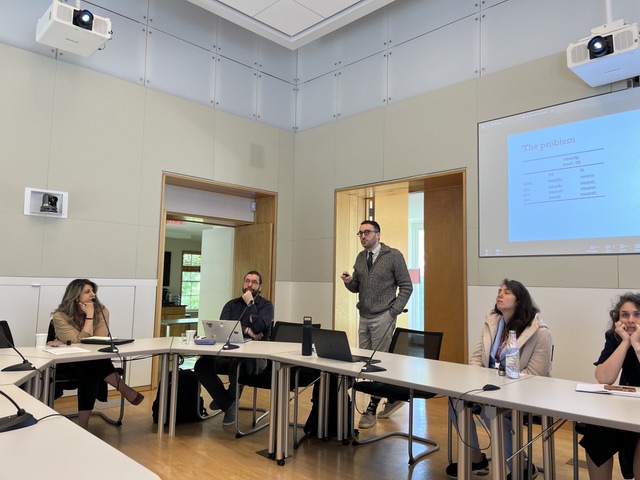
The fellowship also empowered me to share these findings widely. Over the past year, I presented part of this research as a Keynote Address at an international conference, through several invited academic lectures, and in university seminars. I am equally proud of my public engagement work, most notably a panhellenic lecture co-organized with the Corinthian Philological Association, Nea Paideia (a journal specialized in Greek secondary education), and nineteen Greek high schools. Bringing morphological theory questions to non-specialist audiences—and to the next generation of students—is something I care about deeply.
Beyond the research itself, the CHS intellectual community proved equally formative. My time in residence at the Center in Washington, DC, offered something that cannot be replicated remotely: sustained, rigorous exchange with exceptional colleagues, whose questions and perspectives have left a lasting imprint on the direction of my thinking.
I look forward to my upcoming visit to the sister Center for Hellenic Studies in Nafplio—and, more broadly, to continuing the research program that this remarkable fellowship year has helped bring into sharper focus.