
Hellenic Studies at CHS: Reflections from Ermioni Prokopaki, Early Career Fellow in Hellenic Studies 2025–2026
The Center for Hellenic Studies is pleased to highlight the work of Ermioni Prokopaki, Early Career Fellow in Hellenic Studies 2025–2026. During her fellowship, which started on July 1, 2025, and will conclude on June 30, 2026, Ermioni advanced her research on Plato's and Aristotle's conceptions of knowledge, mind, and truth-telling. In the guest post below, she reflects on her research and her experience as a CHS fellow.

Other Fellows' work on epigraphy and pottery gave me a richer understanding of the world I engage with through the philosophical works of Plato and Aristotle, and I am grateful for other Fellows' suggestions to look at some texts that I would probably not have considered looking at.
Guest post by Ermioni Prokopaki
I am Ermioni Prokopaki, I recently received my PhD in Philosophy from the University of Chicago, and I had the honor of being an Early Career Fellow at the Harvard Center for Hellenic Studies, Greece in the 2025–2026 academic year. My research centers on Plato and Aristotle and specifically the intersection of Epistemology and the Philosophy of Mind in their work. In other words, I try to understand how each philosopher's conceptions of knowledge and of human intellectual capacities inform each other. This means that my own work often focuses on conceptions of acts of truth-telling.
My dissertation project, on Plato's struggle against the threat of relativism in his Theaetetus, had already begun to explore this interest and this Fellowship has given me the time and resources to develop it further. I am primarily concerned with two main projects. One is new work on the Theaetetus, which considers the curious remark that experts have knowledge of the future. Drawing from relevant passages, I argue that reference to the future is meant to stand for our soul's teleologically structured orientation to the truth, which is also the key in the fight against relativism. A consequence of this is that the knower is one who has self-knowledge of their intellectual activity being subject to standards. At the same time, since these standards come from the object itself and the teleological structure of its activity, the knower is not confined to knowledge of the self. The second project focuses on Aristotle and addresses questions similar to those that are raised in Plato's Theaetetus. Looking at his treatise on the soul (or mind), de Anima, which is conspicuously inspired, at least in part, by the Theaetetus, I argue that it is not very clear that Aristotle views our capacity for judgment as teleologically structured with an aim to the truth. In light of the Theaetetus background, this leaves Aristotle vulnerable to charges of relativism. It is also not very clear that de Anima can make sense of acts of truth-telling as such.
During the time of my Fellowship, I have come to know better and be more involved in the Ancient Philosophy community in Athens, which is dynamic and thriving. I have taken part in short-term workshops and long-term reading groups, I have been invited to guest-lecture in courses and participate in conferences, and I am a regular attendee in various lecture series. Belonging to an intellectual community is very important to me, as consistent dialogue is crucial to my understanding of my own ideas and arguments. This is likely not surprising for a Platonist!
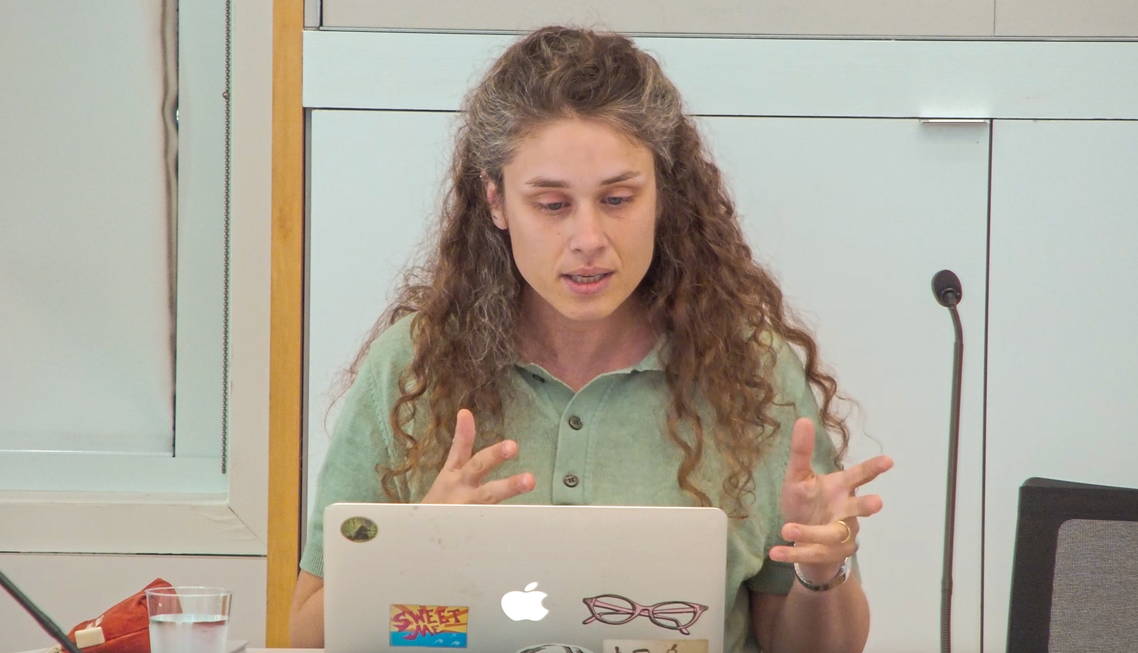
Another major highlight of my academic year has been the trip to the Harvard Center for Hellenic Studies in Washington, DC, in the context of which the current Fellows from both Centers came together to engage with one another's work. While most of us work on completely different things, often in different fields altogether, we were able to give one another valuable feedback and learn from one another, in both official and unofficial contexts. For example, other Fellows' work on epigraphy and pottery gave me a richer understanding of the world I engage with through the philosophical works of Plato and Aristotle, and I am grateful for other Fellows' suggestions to look at some texts that I would probably not have considered looking at. Finally, it was of course wonderful to see in person the campus, and especially the gardens, of Dumbarton Oaks in DC! Overall, I am very grateful for the opportunities given to me by CHS and I look forward to completing my projects.