
A Glimpse into the Conference "Rethinking Archaic Sculpture"
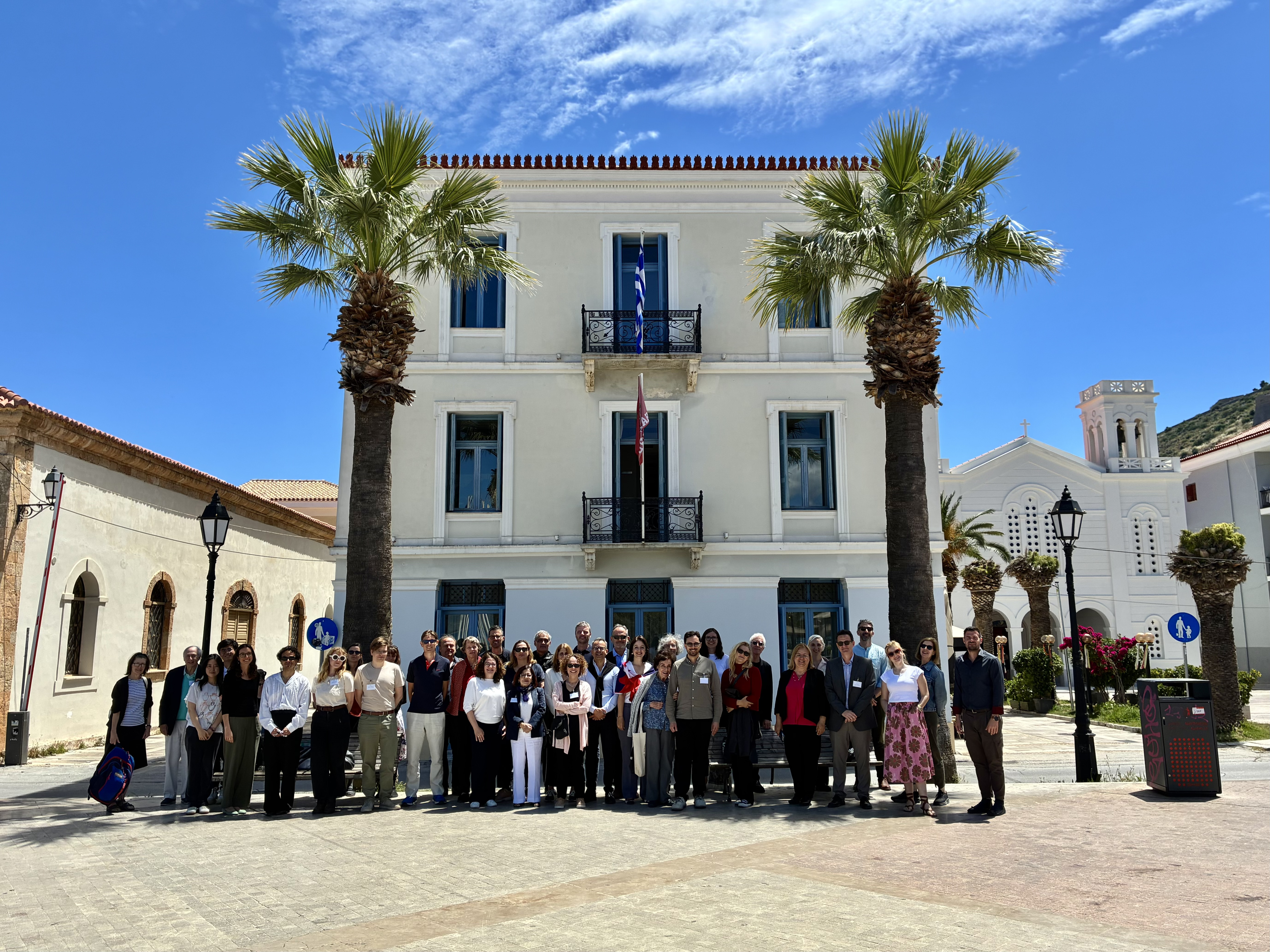
Held in Nafplio at CHS Greece in May 2026, organized by Seth Estrin (Harvard University), Rebecca Levitan (King's College London), and CHS Greece, and supported by King's College London, the conference "Rethinking Archaic Sculpture" brought together leading archaeologists and scholars from universities and institutions worldwide, opening new lines of inquiry into Archaic Greek sculpture and highlighting the collaborative, interdisciplinary future of the field. This guest post, written by Seth Estrin (Harvard University) and Rebecca Levitan (King's College London), offers an insider's view of the conference's highlights.
Guest post by Seth Estrin and Rebecca Levitan
From May 13 to 15, 2026, several of the world's foremost specialists in ancient sculpture gathered in Nafplio from across Europe and the United States to explore the sculpture of the Archaic Greek world. As the first instance of monumental sculpture in the classical tradition, Archaic sculpture establishes the origins and early development of one of the most influential sculptural paradigms in the entire world history of art. The study of Archaic sculpture has a long and distinguished history, and has been the focus of important previous symposia. The CHS conference was unique, however, in bringing together scholars who study Archaic sculpture and archaeologists responsible for its discovery and publication. The conversations that emerged across the three days opened new pathways of understanding and collaboration that we look forward to building on for years to come.

The conference began with opening remarks that welcomed participants to CHS, and an evening reception that allowed them to take in the stunning views of the Nafplio harbor. The following morning, formal presentations began with Christian Kunze (University of Regensburg), whose meticulous study of the evidence for dating the earliest Archaic sculptures offered new insights into chronology, and Milette Gaifman (Yale University), who reconsidered the modern history of the kouros as a category of sculpture. Two papers on the monumentality of Archaic sculpture followed, one by Gianfranco Adornato (Scuola Normale Superiore, Pisa), who offered a sweeping examination of the rhetoric of carving from a single block across the Greek world, and the other by Rebecca Levitan (King's College, London), who gave us a vivid picture of the mechanics of quarrying monumental sculpture on Naxos.
The afternoon session offered an exciting series of new discoveries that together reshape our understanding of Archaic sculpture. Zozi Papadopoulou (Ephorate of Antiquities of Cyclades, Greek Ministry of Culture) and Eleni Kalavria (Ephorate of Antiquities of Cyclades, Greek Ministry of Culture) took us to the Cyclades, presenting an inscribed and sculpted funerary stele from Paros and an early kouros head from Naxos, each of which offers new insights into broader traditions. Elena Walter-Karydi (University of Saarland) introduced the kouroi from Klenia, one of the most spectacular finds of Archaic sculpture in recent decades, while Margherita Bonanno (Tor Vergata University of Rome) showed us an astonishing range of new finds from Thebes, whose Archaic sculpture has previously been underexplored. The next two talks took us to the Athenian Acropolis. Raphaël Jacob (Acropolis Museum) unveiled a new Archaic pediment that he painstakingly pieced together from blocks in the museum storerooms, while Elisavet Sioumpara (Acropolis Restoration Service, Greek Ministry of Culture) demonstrated that sculptural fragments previously assigned to the metopes of the Archaic Parthenon might have belonged to an entirely different feature of the temple. Finally, Wolf-Dietrich Niemeier (Emeritus Director, DAI Excavations Kerameikos) and Vasiliki Barlou-Jäggi (Antikenmuseum Basel) brought us to the Athenian Kerameikos, giving us new insights into a spectacular kouros and a pair of sphinxes that were discovered there.

The next morning, we returned to new approaches with two papers on bronze: one by Caspar Meyer (Bard Graduate Center) focused on how the making of sphyrelata—early hammered bronze sculptures—generates a distinctive form of technical knowledge, and the other by Seth Estrin (Harvard University) examining connections between the kouros and early Greek body armor. The last paper, presented by Nikolaus Dietrich (Heidelberg University), offered a new look at Archaic sculpture through Roman eyes. In a final roundtable discussion, Nikolaos Papazarkadas (University of California, Berkeley/Institute of Historical Research, National Hellenic Research Foundation), Marion Meyer (University of Vienna), and Verity Platt (Cornell University) brought together the various strands of the conference, helping us see common themes that had arisen, outstanding questions, and connections with the study of other facets of the Archaic world.
The conference ended on a high point when, following the final discussion, the speakers and moderators traveled together to Corinth to look at the kouroi from Klenia. Having the opportunity to examine these magnificent new discoveries in the company of Dr. Walter-Karydi, one of the most distinguished scholars of Archaic sculpture and a contributor to their first publication, was a moment none of us will soon forget.


For additional photographs and visual material, see the links below on CHS Greece's social media accounts: